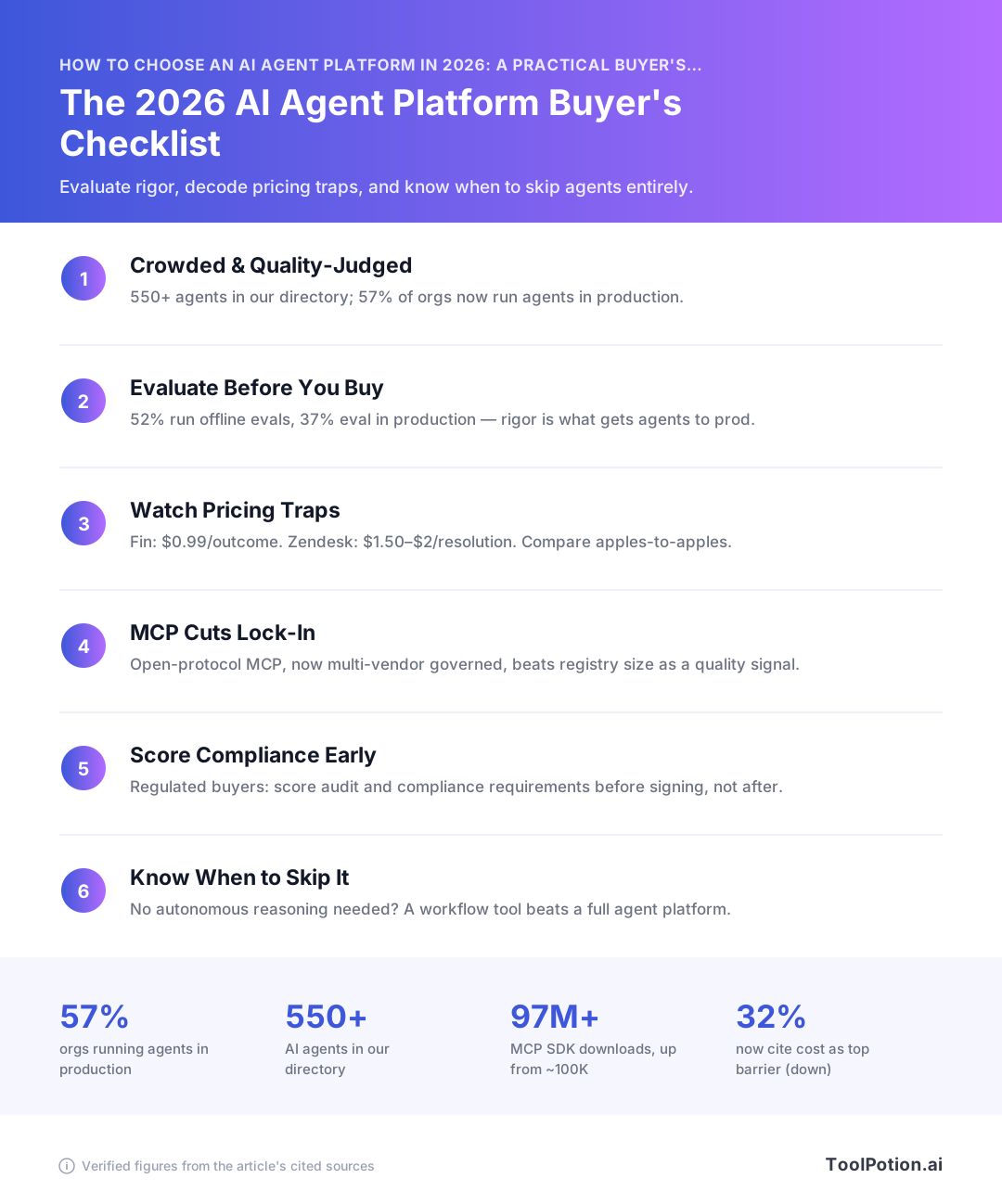
550 AI agents are cataloged in our directory right now — not a marketing top-10, an actual longlist — and picking the wrong one is no longer mainly a budget problem. In LangChain's 2026 survey of 1,300+ practitioners, only 32% now name cost as their top barrier to production agents; quality problems like hallucinations and evaluation gaps have overtaken it (LangChain).
That shift matters because 57% of organizations already run agents in production, up from 51% a year earlier (LangChain), so you're not evaluating a novelty anymore — you're evaluating infrastructure. This guide walks through the evaluation criteria, the pricing traps hidden in seat, usage, and outcome-based SKUs, and the one test that tells you when a workflow tool beats an agent platform outright.
The AI Agent Platform Market in 2026: Bigger, Crowded, and Judged on Quality Now
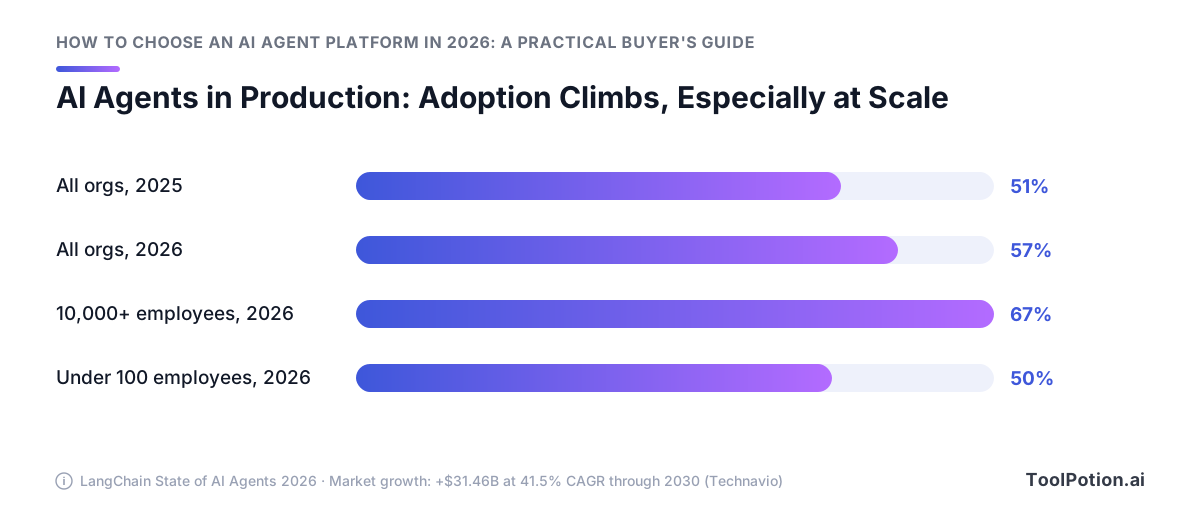
AI agents aren't experimental anymore. 57% of organizations now run AI agents in production, up from 51% a year earlier, according to LangChain's 2026 State of Agent Engineering report (surveying 1,300+ practitioners). That figure climbs to 67% at companies with 10,000+ employees but sits at only 50% for companies under 100 employees.
The gap tells you something important: larger enterprises have the evaluation infrastructure and risk tolerance to deploy agents at scale, while smaller teams are still prototyping or waiting for clearer quality signals. You're choosing from a genuinely crowded field—our directory alone tracks 550 AI agent platforms, and curated industry lists count anywhere from 120 to 600+ legitimate products.
Adoption is real but uneven by company size
The production adoption rate varies by 17 percentage points between large enterprises and small companies. If you're at a sub-100-employee organization, you're in the cohort where half your peers haven't deployed agents yet—which means you have more time to evaluate carefully, but also less peer data to learn from. At 10,000+ employees, two-thirds of your peers are already running agents, so the question shifts from whether to which platform and how to evaluate quality.
Cost is no longer the top objection — trust is
Only 32% of practitioners now cite cost as their top barrier to production agents. Quality problems—hallucinations, evaluation gaps, and trust in delegation—have overtaken cost as the leading blocker. This reframes your buying decision: you can't shop on price alone anymore. The platform that charges less per action but ships agents you can't trust in production will cost you more in engineering time, rollback expenses, and customer-support escalations than a higher-priced platform with robust evaluation tooling and guardrails baked in.
The Evaluation Criteria That Actually Predict Success
The gap between pilots that stall and agents that reach production isn't the model you pick. It's whether the vendor gives you the evaluation, integration, and exit machinery to trust the thing in front of customers. Score any platform you're considering against these three questions before you sign.
Does the vendor support real evaluation and observability?
Teams that ship agents to production evaluate them at higher rates than teams still prototyping. In LangChain's 2026 survey, 52% of teams run offline evals and 37% evaluate agents in production — and that gap tracks directly with which teams clear the production bar. If a platform can't show you trace-level logs, offline eval harnesses, and a way to catch regressions before a release, treat that as a blocker, not a nice-to-have.
Ask vendors for a live walkthrough of a failed run, not a demo of a successful one. How you debug a hallucinated tool call or a bad delegation decision tells you more than any accuracy benchmark.
Is the platform built on an open integration standard?
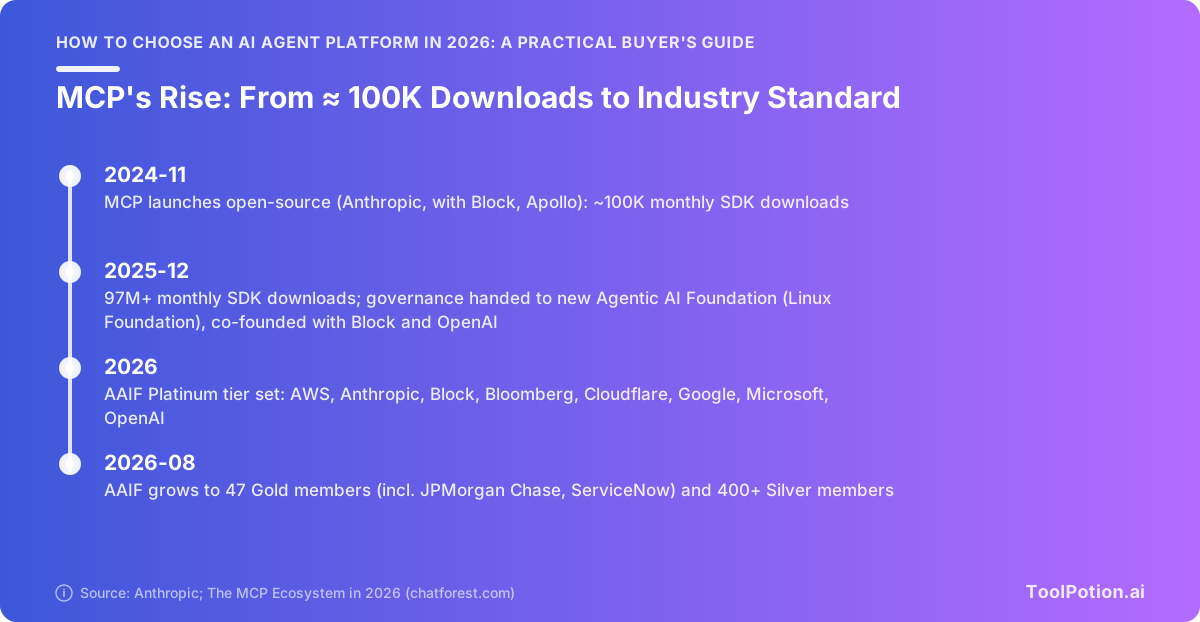
Check whether the platform speaks MCP (Model Context Protocol) natively or locks you into proprietary connectors. Anthropic open-sourced MCP in November 2024, and by December 2025 governance had moved to the Agentic AI Foundation, a Linux Foundation effort co-founded with Block and OpenAI and joined by Google, Microsoft, AWS, Cloudflare, and Bloomberg — removing the single-vendor risk that used to be a real procurement objection. Adoption backs this up: MCP SDK downloads went from roughly 100,000 a month at launch to 97 million a month by December 2025. A platform still shipping closed, vendor-specific tool integrations in 2026 is asking you to bet against where the ecosystem already moved.
Who owns your data and workflow logic if you leave?
Before you commit, get a straight answer on data portability: can you export your prompts, tool definitions, eval sets, and conversation logs in a usable format, or are they trapped in the vendor's console? This matters more for agent platforms than it did for prior SaaS generations, because the workflow logic — not just the data — is often the asset you built. If you're evaluating narrower automation or machine learning platforms alongside general agent builders, apply the same portability test; lock-in risk doesn't shrink just because the tool's scope is smaller.
Pricing Models Compared: Seat, Usage, and Outcome-Based Traps
Per-seat pricing is fading fast
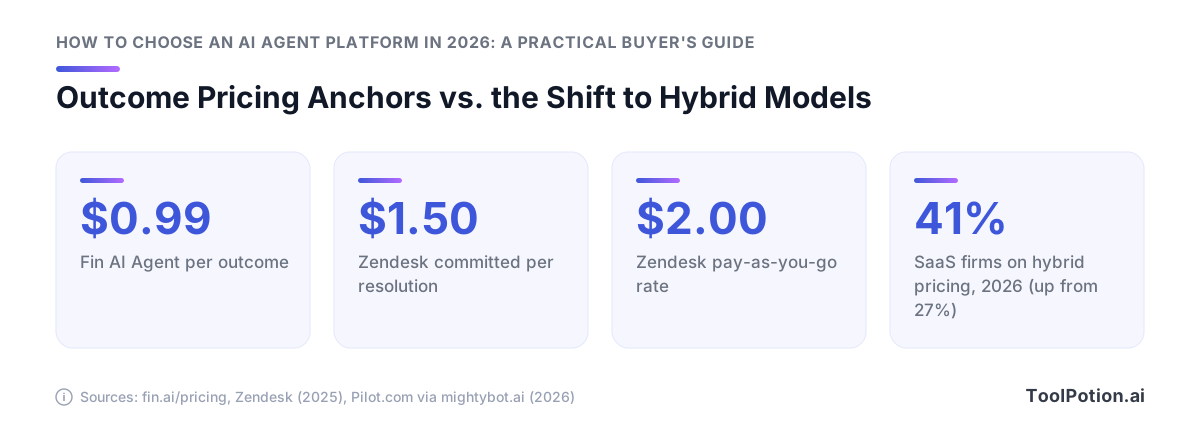
If a vendor quotes you a flat per-seat license, treat it as a signal of where the product roadmap is, not just a price tag. Seat-based pricing dropped from 21% to 15% of SaaS companies in the past 12 months, while hybrid models mixing seats, usage, and outcomes rose from 27% to 41% over the same period (MightyBot). An agent doesn't sit in one seat and do one job the way a human license implies — it fires thousands of times a day, so vendors are moving pricing to match actual usage.
That shift matters for your budget forecasting. A per-seat quote is easy to model but disconnected from how the agent actually scales; a usage or outcome quote scales with your workload, which is more honest but harder to cap.
Outcome-based pricing: read the fine print on 'outcome'
Outcome-based pricing sounds simple — pay for results, not seats or tokens — but "outcome" is defined differently by every vendor, and that definition is where the real cost lives. Intercom's Fin AI Agent charges $0.99 per billable outcome, defined as a confirmed or assumed resolution, a procedure handoff, or a disqualification; lead-qualification outcomes cost $9.99, and escalations to a human aren't billed (Fin AI Agent Pricing). On standalone (non-Intercom) helpdesks, Fin has a $49/month floor covering 50 resolutions, with every additional resolution at $0.99 and no disclosed volume discounts (Fin AI Agent Pricing).
Zendesk's outcome-based model charges $1.50 per automated resolution on committed volume, or $2.00 pay-as-you-go, also with no charge for human escalations (Zendesk).
Both vendors exclude escalations from billing, which is good for your budget but also creates an incentive misalignment worth probing in the sales call: ask exactly what counts as a resolution, whether a customer re-contacting on the same issue triggers a second charge, and whether "assumed resolution" (Fin's term) means the agent closes the ticket without customer confirmation.
Doing the math before you sign
Run your own volume through each vendor's formula before comparing headline rates. At 5,000 resolutions a month, Fin's standalone plan runs roughly $49 base plus 4,950 × $0.99 ≈ $4,950, versus Zendesk's committed-volume rate of 5,000 × $1.50 = $7,500 — a gap that only shows up once you multiply by your actual ticket volume, not the per-unit price alone.
Integration and Lock-In: Why MCP Support Is Now a Checklist Item
What MCP solved and why vendors adopted it fast
Before the Model Context Protocol, every agent platform wired up data sources and tools with its own custom connectors. Switching platforms meant rebuilding every integration from scratch — that's the lock-in cost you're actually paying for when a vendor has no open protocol support.
Anthropic open-sourced MCP in November 2024, and it didn't stay a single-vendor project for long. In December 2025, Anthropic donated MCP governance to the newly formed Agentic AI Foundation, a Linux Foundation directed fund co-founded with Block and OpenAI, with Google, Microsoft, AWS, Cloudflare, and Bloomberg joining as members — the kind of multi-vendor governance that removes "whose roadmap am I betting on" as a procurement objection (chatforest.com). Adoption followed the governance shift: MCP's monthly SDK downloads went from roughly 100,000 at launch to more than 97 million by December 2025 (chatforest.com). When you're evaluating a platform, ask whether it speaks MCP natively — it's the difference between portable tool connections and a proprietary integration layer you'll have to rebuild if you switch vendors.
Registry size is not a quality signal
Don't let a vendor's "connects to X thousand tools" claim substitute for due diligence. By August 2026, the Glama registry alone indexed more than 71,000 MCP servers, and MCP Toplist counted nearly 101,000 across combined registries — but that same tracking notes the totals are inflated by abandoned and duplicate listings (chatforest.com). A large registry number tells you the ecosystem is active. It tells you nothing about whether the specific server you need is maintained, secure, or even functional — test the actual integration before you count it as a checklist win.
Regulatory Exposure: What Changes If You're in a Regulated Industry
If you're evaluating agent platforms for finance, healthcare, or legal work, compliance can't be a question you ask after the contract is signed. Fine tiers and audit obligations under the EU AI Act should factor into vendor scoring the same way pricing and integrations do, because retrofitting compliance into a deployed agent is far more expensive than screening for it upfront (Gera Compliance).
The EU AI Act timeline buyers need to track
The Act's enforcement framework applies tiered fines depending on the violation, and the applicable deadlines for high-risk AI systems have shifted — details your vendor should be able to explain clearly, not gloss over (Gera Compliance).
Ask any prospective vendor directly: which risk tier does your agent fall into, what audit logs do you retain, and who is liable if the agent makes a decision that triggers a fine. If the sales team can't answer those questions on the call, treat that as a disqualifying signal, not a follow-up item.
When You Don't Need an Agent Platform at All
Not every automation problem needs an agent. If the steps from input to output are fixed and you can draw them as a flowchart, you're describing a workflow, not a task that requires open-ended reasoning — and a workflow tool will be cheaper, faster to debug, and more predictable than any agent platform.
The decision test: deterministic workflow vs. open-ended reasoning
Ask one question: does the task ever require the system to decide what to do next based on ambiguous input, or does it just require the system to do the same steps every time? If a new hire form always triggers the same five downstream actions in the same order, that's deterministic — no agent needed. If a support ticket might need a refund lookup, a policy check, an escalation, or all three depending on what the customer actually wrote, that's open-ended reasoning, and it's what agent platforms are built for.
A second test: count the branches. A process with two or three well-defined conditional paths is still a workflow. A process where the number of reasonable paths depends on the input's content — free text, unstructured documents, a conversation that can go anywhere — is where an agent's judgment starts to earn its cost.
Signs a workflow tool like n8n or Zapier is the better fit
- Every run follows the same sequence of steps, regardless of input content
- You can write the logic as if-this-then-that rules without leaving anything to interpretation
- The task doesn't require reading unstructured text and deciding what it means
- You need guaranteed, auditable, identical output every time — not a best judgment call
- Your team can maintain it without evaluation infrastructure, since there's no model output to grade
Buying agent infrastructure for a deterministic task doesn't just waste budget — it adds a layer of non-determinism to a process that didn't need one, which makes debugging harder, not easier.
How to Shortlist: A Practical Framework Using Directory-Scale Data
Skip the marketing top-10. Start from a longlist of real candidates, filter hard on your own constraints, then run a paid pilot before anyone touches a contract.
Score against your 3 non-negotiables first
Pick three requirements you already validated in the earlier sections — for example, MCP support, an outcome-based pricing option, and an exit path that doesn't strand your integrations. Build your longlist from a category page, not a listicle: the AI Agent Builders category and the AI Platforms directory both let you filter by feature rather than trust whoever paid for placement.
Cut anything that fails one of your three non-negotiables immediately — don't rank it lower, remove it. A platform that can't clear your compliance bar or your pricing model isn't a lower-priority option, it's not a candidate.
- List every platform that plausibly fits your use case, no matter how unfamiliar
- Mark yes/no on each of your three non-negotiables — no partial credit
- Drop anything with a no; keep a shortlist of 3-5 survivors
Pilot with an outcome-based cap before you commit to seats
Once you have survivors, negotiate a capped pilot instead of a seat license. Ask each vendor for a per-outcome or usage-based trial period, even if their standard contract is seat-based — most will offer one to win the deal.
Set a hard cap on spend and a fixed evaluation window, then measure the same things you'd check in production: resolution rate, escalation rate, and cost per successful outcome. If a vendor won't structure a pilot this way, treat that reluctance as data about how they'll handle a renewal negotiation later.
Frequently Asked Questions
What's the difference between an AI agent and an AI agent platform?
An AI agent is a single autonomous system that plans and executes multi-step tasks with some degree of independence — our directory currently catalogs 550 of them (/en/type/ai-agent). An AI agent platform is the surrounding infrastructure layer: the tooling to build, deploy, connect, monitor, and evaluate one or many agents, often bundling agent builders (553 listings in our directory at /en/category/ai-agent-builders) with orchestration, integrations, and observability. When you're comparing vendors, check whether you're buying a single agent product or the platform layer underneath it — the pricing and lock-in tradeoffs differ substantially.
How much does an AI agent platform cost in 2026?
Pricing has shifted from flat seats toward usage- and outcome-based models: a Pilot.com study cited by MightyBot found seat-based pricing among SaaS companies dropped from 21% to 15% of companies in 12 months while hybrid pricing (seats plus usage or outcomes) rose from 27% to 41% over the same period (MightyBot). Concretely, Intercom's Fin AI Agent charges $0.99 per billable outcome (with a $49/month floor covering 50 resolutions on the standalone plan) (Fin AI Agent Pricing), while Zendesk charges $1.50 per resolution on committed volume or $2.00 pay-as-you-go (Zendesk). Run the per-outcome math against your actual volume before signing — a per-conversation SKU and an equivalent action-based SKU can land far apart in total cost at scale.
Do I need an AI agent platform, or would a workflow tool like n8n or Zapier work?
If your process is a fixed sequence of steps with predictable branching, a workflow tool is usually the better fit — it's cheaper, easier to debug, and doesn't require managing model reasoning failures. Reach for an agent platform when the task requires the system to make judgment calls with incomplete information, adapt its own steps, or delegate decisions rather than follow a predetermined path. That distinction matters more now that quality problems, not cost, are the top-cited barrier to production agents — 32% of practitioners in LangChain's 2026 survey now name cost as their main blocker, with hallucination and evaluation gaps ranking above it (LangChain State of AI Agents Report). If you're not sure your use case needs autonomous decision-making, start with the workflow tool and only move to an agent platform once you hit its limits.
What is MCP and why does it matter when choosing an AI agent platform?
MCP (Model Context Protocol) is an open standard for connecting AI agents to external tools and data sources, open-sourced by Anthropic in November 2024 with launch partners Block and Apollo (Anthropic). In December 2025 Anthropic transferred MCP governance to the Agentic AI Foundation, a Linux Foundation directed fund co-founded with Block and OpenAI and joined by Google, Microsoft, AWS, Cloudflare, and Bloomberg — removing the single-vendor governance objection that had been a procurement blocker for enterprise buyers (Anthropic). Adoption has scaled accordingly: monthly SDK downloads went from roughly 100,000 at launch to over 97 million by December 2025 (ChatForest). When evaluating a platform, check whether it speaks MCP natively rather than a proprietary connector format — it directly affects how easily you can swap tools or vendors later without rebuilding integrations.
How many AI agent platforms are actually on the market right now?
Our own directory currently catalogs 550 AI agents (/en/type/ai-agent) and 553 listings under AI Agent Builders (/en/category/ai-agent-builders), out of 18,825 active listings total across the site. Treat any "top platforms" ranking with a small named list — 10 to 20 vendors — as a curated sample rather than the full market; the category is large and shifting quickly enough that a short list can't represent it. Whatever list you're working from, verify it discloses its sample size and methodology before treating a ranking as comprehensive.