Run 5 agents and 4,000 AI resolutions a month on Intercom's Advanced plan, and you'll pay roughly $4,385/mo: $425 in seats plus 4,000 resolutions x $0.99 (Intercom). The same 5 seats on Zendesk's Suite Team plan run $275/mo, and if all 4,000 resolutions billed at the estimated $1.50-$2.00 overage rate, that adds $6,000-$8,000 more — a ceiling, not a guarantee, since Zendesk's 2026 tiers exclude some interaction types from billing entirely (Zendesk; Voiceflow). ChatGPT Business, by contrast, is a flat $100/month for 5 seats no matter how many tickets come in, because it isn't billing per resolution at all (CloudZero). Below, plug in your own seat count and volume to see which model actually wins for your budget.
Why AI chatbot pricing got so hard to compare in 2026
A price tag isn't the same unit twice. One vendor charges per human agent, another charges per AI resolution, a third charges per token consumed. You can't drop these into the same spreadsheet column without converting them first, and vendors don't make that conversion easy.
Per-seat, per-resolution, and per-token: three different bills
Seat-based pricing charges per human who logs in, regardless of how much the AI does. ChatGPT Business is flat per-seat pricing — $20/user/month on annual billing, $25/month billed monthly, with a 2-seat minimum — and that price doesn't move whether your bot handles ten conversations or ten thousand (CloudZero).
Outcome-based pricing charges per unit of AI work instead. Intercom's Fin AI Agent is $0.99 per resolution across every Intercom plan, on top of seat fees for your human agents (Intercom). Zendesk blends the two: you still pay per agent seat, but AI usage is metered separately as "Automated Resolutions" (Zendesk).
Token-based pricing, typical of self-hosted or API-driven bots, charges for raw model consumption — input and output tokens — with no seat or resolution concept at all. Cost scales with conversation length and model choice, not headcount.
Why the same bot can cost 10x more at one company than another
Two teams running what looks like the same chatbot can land on wildly different bills, because the pricing model interacts with how the bot is actually used. A company with five support agents and a high-volume AI deflecting thousands of tickets pays mostly for resolutions, not seats. A company with fifty agents and a bot that only handles simple FAQs pays mostly for seats, with AI as a rounding error.
That's before you factor in what counts as a billable event in the first place — definitions vary by vendor and change over time, which is exactly what the next section digs into. Browse the 395 AI chatbot tools we track to see how many different pricing structures are actually out there before you commit to a model.
Build your own AI chatbot budget: interactive cost calculator
Enter your seats, ticket volume, and expected resolution rate
Three numbers drive every commercial chatbot bill: how many human seats you need, how many conversations the AI handles per month, and what fraction of those it actually resolves without escalation. Plug those into the platforms below instead of comparing sticker prices, because sticker prices assume a mix that may not match yours.
Start with seats. If you run 5 agents on Intercom's Advanced plan at $85/seat/month (annual billing), that's $425/month before a single AI resolution is billed (Intercom). The same 5 agents on Zendesk's Suite Team plan at $55/agent/month run $275/month, or $575/month on Suite Professional at $115/agent/month (Zendesk).
Next, estimate monthly resolution volume: total conversations multiplied by the resolution rate you expect the AI to hit, not the vendor's headline number. That volume is what gets multiplied against the per-resolution rate in the next step.
See Intercom Fin, Zendesk AI, and ChatGPT Business side by side
| Platform | Seat cost (5 seats, annual) | AI usage cost | Formula |
|---|---|---|---|
| Intercom (Advanced) | $425/mo (Intercom) | $0.99 × resolutions | $425 + (resolutions × $0.99) |
| Zendesk (Suite Team) | $275/mo (Zendesk) | Automated Resolutions allowance, overage priced by Zendesk | $275 + overage resolutions × your negotiated rate |
| ChatGPT Business | $100/mo (5 seats × $20, annual) | No per-resolution fee; usage is seat-based | 5 × $20 = $100 flat |
Run your own volume through it: at 1,000 Fin resolutions a month, Intercom's usage line alone is $990, on top of the $425 in seats. Zendesk's equivalent depends on your committed allowance and negotiated overage, since Zendesk doesn't publish a flat per-resolution rate (Zendesk). ChatGPT Business stays flat regardless of ticket volume, because it isn't billing per resolution at all.
Intercom Fin vs Zendesk AI pricing: seat cost plus resolution fees compared
Fin's $0.99-per-outcome model, including the standalone floor
Intercom bills Fin AI Agent at a flat $0.99 per resolution across every Intercom plan — Essential, Advanced, and Expert all include Fin access at the same per-outcome rate (Intercom Pricing). Seats are separate: Essential runs $29/seat/mo, Advanced $85/seat/mo, and Expert $132/seat/mo on annual billing, so your floor is seat cost plus whatever resolutions Fin logs that month.
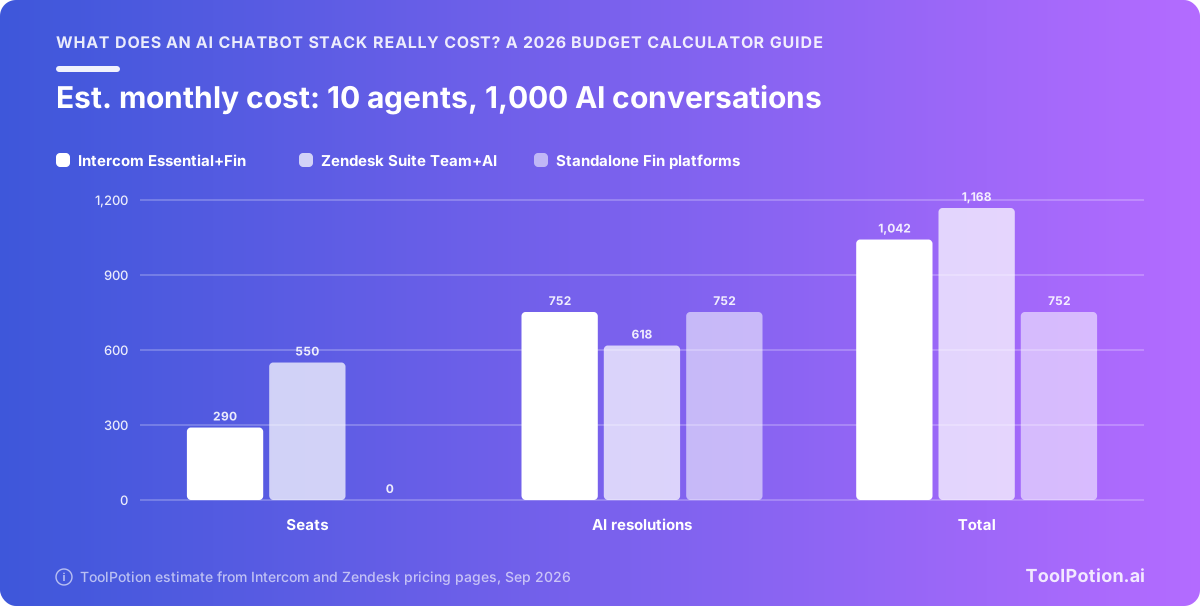
If you want Fin without Intercom's own helpdesk, the standalone "Fin for platforms" tier still charges $0.99 per outcome but adds a 50-outcome monthly minimum — roughly a $49.50/month floor — with no seat fees at all (getmacha.com).
Not every Fin interaction counts as a billable outcome. A resolution, a procedure handoff, or a disqualification each bill at $0.99, while a lead qualification bills at $9.99. You aren't charged if the customer asks for a human or a procedure fails, and a resolution gets refunded if the conversation later reopens (Gleap.io).
Zendesk's bundled resolutions and the 2026 verified-resolution tiers
Zendesk folds AI agents into every Suite and Support plan — Support Team at $19/agent/mo, Suite Team at $55/agent/mo, Suite Professional at $115/agent/mo — and meters usage as "Automated Resolutions" rather than charging a separate per-bot fee. Zendesk doesn't publish an overage rate on its own pricing page (Zendesk Pricing).
That changed in May 2026, when Zendesk split resolution billing into three tiers: Assisted Escalation and Contained Resolution no longer count against your allowance at all, and only Verified Resolutions draw down the paid quota (eesel.ai). Third-party estimates (not Zendesk-published) put overage resolutions at roughly $1.50 each on committed volume, about $2.00 pay-as-you-go, trending toward $1.00 at very high volume (Voiceflow).
Where each model wins depending on your ticket mix
Fin's flat $0.99 is easier to forecast and cheaper per unit if most of your volume is genuine resolutions. Zendesk's tiered model can cost less if a large share of your bot traffic ends in an assisted escalation or contained resolution, since those no longer draw from the paid pool at all (eesel.ai). Run both scenarios against your own resolution mix before committing to either platform.
ChatGPT Business and Claude Team: per-seat AI assistants vs purpose-built support bots
ChatGPT Business and Claude Team Standard both cost $20 per seat per month on annual billing ($25 monthly), with a two-seat minimum. That's a fixed line item: five seats cost $100/month, fifty cost $1,000/month, and resolution volume doesn't change the bill.
These platforms are internal productivity tools—your support team uses them to draft replies faster, summarize threads, or research knowledge-base articles. They don't answer customer tickets autonomously or trigger Intercom's $0.99 resolution charge when they close a conversation.
What $20/seat actually buys you
That $20 buys a flat seat license, not a usage meter — the price is the same whether an agent sends ten messages a day or two hundred. OpenAI dropped the annual price from $25 to $20 in April 2026, matching Anthropic's seat rate for Claude Team Standard (Claude Pricing).
The seat model makes budgeting simple: multiply agent headcount by $20. No resolution tracking, no overage invoices, no deflection-rate guesswork.
Why a general assistant isn't a drop-in replacement for Fin or Zendesk AI
ChatGPT Business won't read your ticketing queue, route conversations, or mark a case resolved in Intercom or Zendesk. It's a chat window your agents open in a browser tab, not an integration that intercepts inbound support requests.
If you want the AI to be the first responder—greeting the customer, pulling order history, and closing tier-one questions before a human sees them—you need a purpose-built agent like Fin or Zendesk AI. If you want to accelerate the humans you already staff, a per-seat assistant cuts reply time without adding per-resolution fees.
The budget trade-off is straightforward: $20/seat scales with team size, $0.99/resolution scales with ticket volume. When your agent count is fixed but inquiry volume spikes seasonally, per-resolution pricing can cost less. When you're hiring and volume stays flat, seats add up faster.
Open-source and self-hosted chatbots: the hidden engineering line item
Open-source frameworks remove per-seat fees and per-resolution charges entirely. Nobody bills you $0.99 per outcome. But the calculator's "free" row is misleading if you stop at the license cost — you're trading vendor fees for engineering time and API usage, and both show up on a budget eventually.
Rasa and friends: no license fee, real build cost
Building a production-grade bot on a framework like Rasa runs an estimated $30,000 to $60,000 in developer time — roughly two to three months of ML engineer work. That covers intent design, training data, integration with your helpdesk or CRM, and testing before the bot handles real customers.
Compare that to Intercom or Zendesk, where the seat and resolution fees already include the underlying model, the training pipeline, and ongoing maintenance. Open source only wins the budget comparison if you're running at a volume where the build cost amortizes below what per-resolution fees would have charged, or if you need control the hosted platforms don't offer — data residency, custom routing logic, or a model swap mid-year. If you're scoping vendors for that kind of custom build, our AI Agents directory lists options beyond the two platforms compared above.
Token costs when you bring your own LLM
A self-hosted bot still needs a language model behind it, and that's a metered bill separate from the build cost. If you route conversations through OpenAI's API, you pay per-token pricing published on OpenAI's developer pricing page; route through Anthropic's models instead and you pay Anthropic's own per-token API rates. Neither charges per seat or per resolution — you pay for every token in and out, regardless of whether the conversation resolves.
That means your real self-hosted total is build cost plus a token bill that scales with conversation volume and length, not a flat monthly number. Budget for both before you count open source as the cheap option.
Where the ROI math breaks down: resolution rates, deflection, and surprise overage
Vendor-claimed resolution rates vs real-world deflection
Intercom publishes a 76% average Fin resolution rate across its 12,000+ customers (theaiagentindex.com). That number belongs to Intercom's best customers, not necessarily you. Independent data on enterprise tier-1 deflection puts the 2026 median at 41.2%, with only the top quartile reaching 58.7% (eesel.ai).
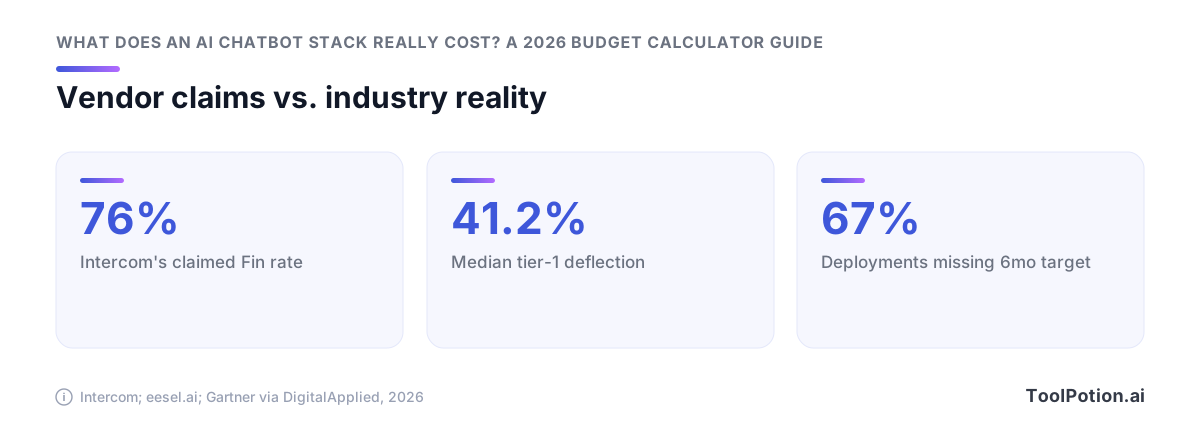
That gap matters because per-resolution pricing means your bill scales with the resolution rate you actually hit, not the one on the vendor's slide. If you budget around 76% and land at 41%, you're not just resolving fewer tickets automatically — you're paying human-agent costs on the difference too, and those aren't interchangeable line items. Gartner's median cost per contact is $1.84 for self-service versus $13.50 for assisted support (digitalapplied.com), so a missed deflection target doesn't just erode savings, it can flip the ROI case entirely. And 67% of AI deployments miss their deflection targets within six months (digitalapplied.com) — treat that as the base rate, not the exception, when you model your own numbers.
How Zendesk's automatic overage billing can blow up a budget
Since January 2026, Zendesk automatically bills for resolutions above your committed monthly volume with no notification before the charge hits (eesel.ai). The earlier system required you to manually activate overage; now it's on by default. A traffic spike or a marketing campaign that drives more conversations than planned turns into an invoice line you didn't approve.
Which pricing model fits your support volume? A decision guide
The seat-vs-outcome split isn't just a billing detail — Intercom's own comparison of Fin, Zendesk, and Agentforce frames it as the central question in choosing a support stack: whether you pay for people or pay for results (Intercom Learning Center). Match the model to your ticket pattern, not to whichever vendor pitched you last.
Low-volume or spiky ticket flow: usage-based pricing wins
If your ticket volume swings by season, launch cycle, or marketing campaign, a per-resolution model like Fin's $0.99/outcome scales down with you in the quiet months — you're not paying for idle agent seats (Intercom Pricing). The same logic applies to standalone Fin for platforms, where the only floor is the 50-outcome monthly minimum, around $49.50 (getmacha.com).
Steady high-volume teams: bundled per-seat plans win
If ticket volume is predictable and high, a flat seat fee gets cheaper per ticket as volume rises, while pay-per-resolution keeps charging linearly. A Zendesk Suite Team seat at $55/agent/mo (Zendesk Pricing) caps your AI cost exposure in a way that $1.50-$2.00 per resolution overage does not (Voiceflow).
When to just build it yourself
Self-hosting only pencils out if you have the ML engineering time to spend, and even then it's a $30,000-$60,000 build, not a subscription swap (openassistantgpt.io). Below that volume or headcount, a commercial plan is cheaper than the engineer-hours it replaces. To compare options directly, browse AI chatbot platforms by pricing model in our directory.
Frequently Asked Questions
How much does Intercom Fin AI Agent cost per month?
Fin bills $0.99 per resolution as a billable outcome, available across all Intercom plans (Essential $29/seat/mo, Advanced $85/seat/mo, Expert $132/seat/mo on annual billing, each including Fin access) Intercom Pricing. If you run Fin standalone without Intercom's helpdesk ('Fin for platforms'), it's still $0.99 per outcome but with a 50-outcome monthly minimum, roughly a $49.50/month floor and no seat fees Intercom Fin AI Agent: Complete Guide & Pricing (2026). A billable outcome is a resolution, procedure handoff, or disqualification at $0.99, or a lead qualification at $9.99 — you aren't charged if a human is requested or a Fin procedure fails, and resolutions are refunded if the conversation reopens Intercom Fin AI Pricing Explained (2026).
Is Zendesk AI cheaper than Intercom Fin?
It depends on volume and plan. Zendesk includes AI agents in every Suite and Support plan (Support Team $19/agent/mo, Suite Team $55/agent/mo, Suite Professional $115/agent/mo annual) and bills usage as 'Automated Resolutions,' but doesn't publish an official overage rate Zendesk Pricing. Third-party estimates put Zendesk overage resolutions at roughly $1.50 each on committed volume or about $2.00 pay-as-you-go, dropping toward $1.00 at very high volume — cheaper per-unit than Fin's flat $0.99 only at the low end, and potentially more expensive elsewhere since these rates aren't official Zendesk AI Agents 2026: Pricing, Setup, and Best Alternatives. Fin's $0.99 is fixed and published; Zendesk's is estimated and tiered, so you need your own resolution volume to compare accurately.
What happens if I go over my Zendesk AI resolution allowance?
Since January 2026, Zendesk automatically bills for resolutions above your committed monthly volume without prior notification — there's no manual overage activation step like there used to be Understanding Zendesk AI pricing (2026). As of May 2026, Zendesk also restructured billing into three tiers: Assisted Escalation and Contained Resolution are free and don't count against your allowance, while only Verified Resolutions draw down the paid quota Understanding Zendesk AI pricing (2026). Overage pricing itself isn't officially published, though third-party estimates suggest roughly $1.50–$2.00 per resolution depending on commitment level Zendesk AI Agents 2026.
Can I use ChatGPT Team or Business as a customer support chatbot?
ChatGPT Team was rebranded to 'ChatGPT Business' in August 2025 as a naming change only, with no feature difference ChatGPT pricing in 2026. It's priced per seat, not per resolution: OpenAI cut annual-billed seats from $25 to $20/user/month on April 2, 2026 (monthly billing stays $25/user), with a 2-seat minimum ChatGPT pricing in 2026. Unlike Fin or Zendesk AI, it isn't built as a purpose-made support tool with ticketing, resolution tracking, or per-outcome billing — it's a general seat-based workspace, so budgeting for it means multiplying seats rather than modeling resolution volume.
How much does it cost to build and run an open-source AI chatbot like Rasa?
Building a production Rasa bot typically runs $30,000-$60,000 in developer cost, reflecting about 2-3 months of ML engineer time Best Open-Source AI Chatbots in 2026. That figure covers development only — it doesn't include ongoing hosting, model inference, or maintenance costs, so total cost of ownership runs higher than the upfront build. Compare that against Fin's $0.99-per-resolution or Zendesk's per-seat-plus-usage pricing before committing: self-hosting only pays off at volumes and timelines long enough to amortize that $30K-$60K build cost against per-resolution vendor fees. Browse AI Chatbots in our directory for hosted and open-source options side by side.
Is Salesforce's acquisition of Intercom/Fin going to change Fin's pricing?
Not yet. Salesforce signed a definitive agreement to acquire Intercom, the company behind Fin, for roughly $3.6 billion, announced June 15, 2026, with the deal expected to close around Q4 of Salesforce's FY2027, and pricing was unchanged as of the announcement Intercom Fin AI Agent: Complete Guide & Pricing (2026). If you're budgeting now, use the current $0.99-per-resolution rate and existing seat tiers Intercom Pricing, but watch for pricing changes once the acquisition closes given the deal's still roughly a year from finalizing.