Sora's Videos API shuts down on September 24, 2026 — OpenAI gave developers six months' notice on March 24, 2026, and no replacement model is listed. That turns this comparison from a four-way race into three active contenders — Veo 3.1, Runway Gen-4.5, and Kling 3.0 — plus a legacy option you should be migrating off of. Below: real per-second pricing instead of sticker-price tiers, hard output limits, and which tool actually fits your production pipeline.
The Sora Sunset: Why the "Big Four" Just Became a Big Three
If you're building on Sora 2 right now, stop and check your calendar. OpenAI is shutting down the API you're depending on, and the clock started months ago.
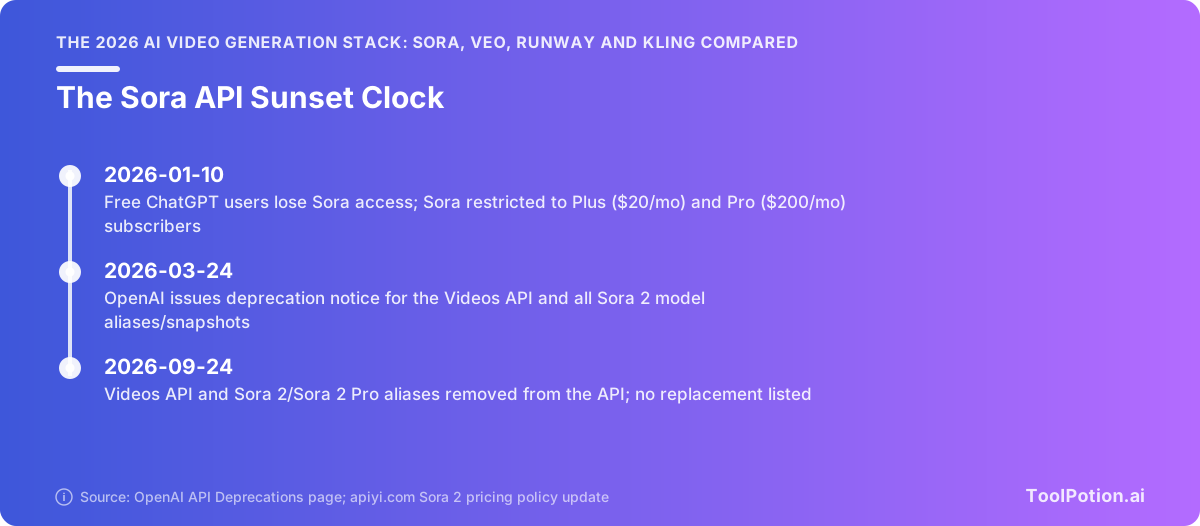
What OpenAI Announced on March 24, 2026
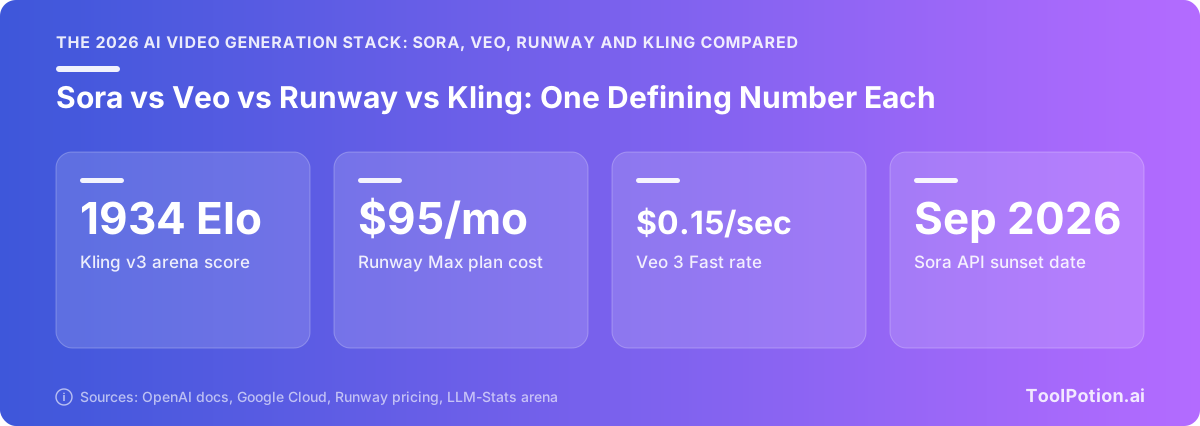
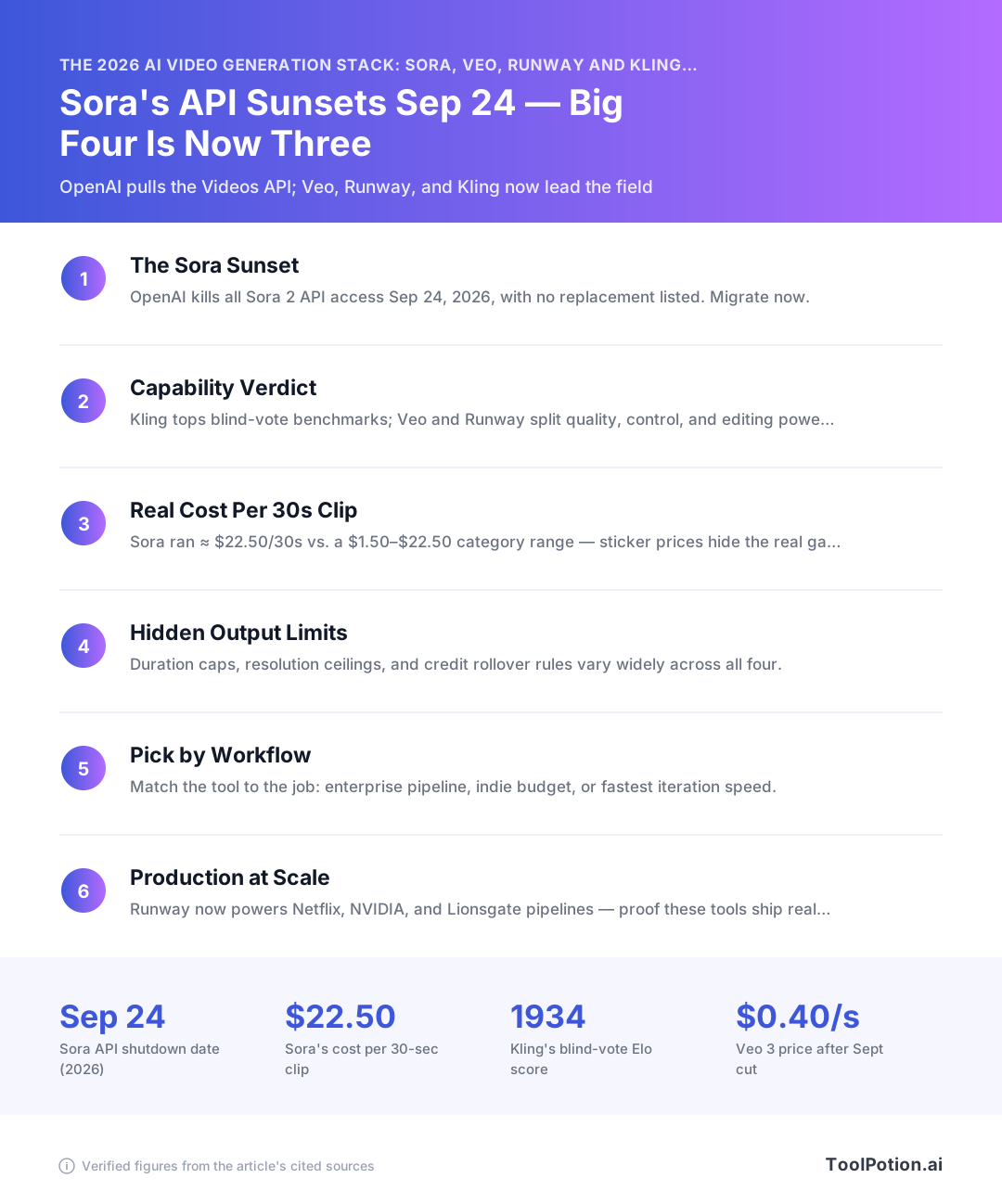
On March 24, 2026, OpenAI notified developers that the Videos API and every Sora 2 model alias and snapshot — sora-2, sora-2-pro, and their dated versions — will be removed from the API on September 24, 2026 (OpenAI). There's no recommended replacement listed in the deprecation notice (OpenAI), which tells you this isn't a migration — it's an exit.
This follows an earlier tightening of access. As of January 10, 2026, free ChatGPT users lost Sora image and video generation entirely; the feature is now restricted to Plus subscribers at $20/month and Pro subscribers at $200/month (apiyi.com). Read together, the two moves show a product being wound down in stages, not one hitting a rough patch.
What the September 24 Shutdown Means for Builders
You have a fixed window, not an indefinite grace period. OpenAI gave roughly six months of notice between the March 24 announcement and the September 24, 2026 cutoff (OpenAI) — treat that date as a hard stop for any product, pipeline, or client workflow that calls the Videos API.
- If you have Sora 2 in production, plan your migration now — there's no official successor API to fall back on (OpenAI).
- If you're evaluating tools for a new project, don't build fresh dependencies on Sora 2 — it's a dead end before most teams could even ship on it.
- If you're a ChatGPT-only user rather than an API integrator, the January 2026 paywall change already means Sora isn't a free option regardless of the API timeline (apiyi.com).
That leaves three platforms actively competing for your workflow going forward: Veo, Runway, and Kling. The rest of this comparison treats Sora as a legacy option, not a going concern.
Sora vs Veo vs Runway vs Kling: Capability Verdict at a Glance
With the Sora API on a countdown, your real shortlist is Veo, Runway, and Kling — plus Sora if you're strictly using the ChatGPT app rather than building on the API. Each tool has a distinct niche rather than a single winner across the board.
Strengths and Weaknesses by Tool
| Tool | Best For | Standout Feature | Biggest Limitation |
|---|---|---|---|
| Veo 3.1 | Teams already on Google Cloud/Vertex | Native audio generation bundled into per-second pricing | Cost climbs fast at 4K with audio — up to $0.60/second (aifreeapi) |
| Runway | Production studios needing a full toolkit | Every paid plan bundles Gen-4.5, Act-Two performance capture, Aleph editing, and third-party models like Kling 3.0 Pro (Creatify-plans-credits-and-what-you-ll-actually-pay)) | Credits burn quickly on Gen-4.5 at 12 credits/second in-app (Unifically) |
| Kling | Raw generation quality | Leads blind-vote benchmarks for text-to-video (llm-stats.com) | Ultra plan price jumped 41% in about six months, from $128/month to $180/month (Atlas Cloud) |
| Sora 2 | ChatGPT Plus/Pro users only, short-term | Familiar ChatGPT integration for casual generation | API shuts down September 24, 2026 with no listed replacement (OpenAI) |
Benchmark Standings: Who's Winning Blind Votes
On blind human-vote arenas, Kling v3 currently sits at the top of the text-to-video leaderboard with a score of 1,934 Elo, based on 1,394 votes as of August 2026 (llm-stats.com). That's a meaningful gap over Runway's Gen-4.5, which launched at 1,247 Elo on the Artificial Analysis benchmark and has since dropped out of the top 10 entirely (Lovart).
Benchmark position isn't the only variable that matters — pricing structure and output limits will decide what you can actually afford to ship. If you want to see how these four stack up against smaller, cheaper alternatives, our directory lists 447 AI video generators in our directory to compare beyond the big names.
Real Per-Second Pricing: What Each Model Actually Costs to Run
Subscription tiers hide the real cost of a video project. Once you convert every plan to a per-second rate, the spread between tools is bigger than the marketing pages suggest — and Sora is no longer the baseline you should be planning around.
Sora 2: $0.10/sec Standard, $0.05/sec Batch (Legacy)
On the API, Sora 2 runs $0.10/second at 720p on the Standard tier, or $0.05/second on the Batch tier if you can tolerate up to 24 hours of latency. Sora 2 Pro costs $0.30 to $0.70/second depending on resolution (aifreeapi). Treat these numbers as historical reference — the API stops accepting requests on September 24, 2026.
Veo 3.1: $0.40-$0.60/sec With Audio
Google cut Veo 3 from $0.75/second to $0.40/second, and Veo 3 Fast from $0.40/second to $0.15/second, effective September 8, 2025 — the same update that added 1080p output and 9:16 vertical support (Google Developers Blog). Veo 3.1 now runs $0.40/second at 1080p up to $0.60/second at 4K with audio, or $0.20-$0.40/second without audio.
Runway: Credit Economics on Standard, Pro, and Max
Runway's 2026 restructure renamed every tier: old Basic became Standard, old Standard became Pro, and old Pro became Max, with the top plan's credit allowance raised to 9,500 credits/month (aumiqx). At $95/month, Max works out to roughly 791 seconds of Gen-4.5 output or 1,900 seconds of Gen-4 Turbo. In-app, Gen-4.5 burns 12 credits/second and Gen-4 Turbo burns 5 credits/second.
Kling: Subscription Tiers and the 41% Price Hike
Kling doesn't publish a per-second API rate for consumer plans — you buy a subscription and spend credits per clip. That subscription got a lot more expensive fast: the Ultra plan rose from $128/month in August 2025 to $180/month in January 2026, a 41% increase in about six months (Atlas Cloud). Budget for further increases if you're locking Kling into a recurring production pipeline.
| Tool | Rate | Est. cost per 30-sec clip |
|---|---|---|
| Sora 2 (Standard, legacy) | $0.10/sec | ~$3.00 |
| Sora 2 Pro (legacy) | $0.30-$0.70/sec | ~$9.00-$21.00 |
| Veo 3.1 (1080p-4K, audio) | $0.40-$0.60/sec | ~$12.00-$18.00 |
| Runway Gen-4 Turbo (API) | $0.05/sec | ~$1.50 |
| Runway Gen-4.5 (API) | $0.12/sec | ~$3.60 |
Output Limits: Duration, Resolution, and Watermark Rules
Max Clip Length and Resolution Ceilings
Veo 3.1 currently leads on raw output ceiling: you can generate up to 4K resolution with audio at $0.60 per second, and Google added 1080p HD plus 9:16 vertical aspect ratio support when it cut Veo 3 pricing in September 2025. Sora 2 API topped out at 720p on the Standard tier ($0.10/second), though the Pro tier pushed resolution higher at $0.30–$0.70/second depending on settings.
Runway's Gen-4.5 consumes 12 credits per second in the app, which translates to $0.12/second on the API where a credit costs a flat $0.01. The Max plan's 9,500 monthly credits buy you roughly 791 seconds of Gen-4.5 footage — about 13 minutes — before you need to top up. Kling v3 holds the highest Elo score in the text-to-video arena (1,934 as of August 2026, based on 1,394 blind votes), but resolution and duration specs aren't broken out in the research pack.
Free-Tier Restrictions and Rollover Rules
Runway's free tier gives you a one-time 125 credits that never expire but never renew — it's a trial, not a production tool. If you're on a paid plan, only the Max tier ($95/month) allows one-month credit rollover-plans-credits-and-what-you-ll-actually-pay); Standard and Pro credits vanish at the end of each billing cycle.
Sora locked out free ChatGPT users entirely on January 10, 2026; access now requires Plus ($20/month) or Pro ($200/month). Veo 3.1 lives inside Google's Vertex AI and Gemini API ecosystem, where billing is strictly pay-as-you-go with no free tier for video generation — you pay $0.40–$0.60/second depending on resolution and audio, and an 8-second clip runs about $3.20.
Watermark policies aren't documented in the research pack, but rollover and expiration rules matter more than most pricing pages admit: if you're budgeting 10 hours of output per quarter, a no-rollover plan forces you into a higher tier or wastes unused credits every month.
Which AI Video Generator Fits Your Workflow
Skip the feature comparison and match the tool to your production pattern. Cost per second and output limits matter differently depending on whether you're posting one clip a day or generating hundreds through an API.
Solo Creators and Social Content
If you're making short-form content solo, Runway's Standard plan at $15/month for 625 credits gives you room to experiment without committing to a heavier tier (Creatify-plans-credits-and-what-you-ll-actually-pay)). At Gen-4 Turbo's 5 credits/second, that's over two minutes of footage a month before you touch overage pricing (Unifically). The free tier's one-time 125 credits work fine for testing the interface, but treat it as a trial, not a workflow — it never renews (Somake.ai).
Agencies and API-Driven Pipelines
If you're billing clients per project and need predictable unit economics, Veo 3.1 through Vertex AI is the more defensible choice at $0.40/second for 1080p with audio (AIFreeAPI). That's a fraction of what Sora 2 costs at $0.10/second on top-tier standard pricing once you account for the API's confirmed shutdown on September 24, 2026 — don't build a client-facing pipeline on a model that won't exist in a few weeks (OpenAI). Runway's developer API is worth a look too, since Gen-4 Turbo runs $0.05/second, undercutting Veo for high-volume, lower-fidelity batches (Unifically). If you're evaluating adjacent models for a specific pipeline step, you can browse AI models by category to see what else fits alongside these four.
Enterprise and Studio Production
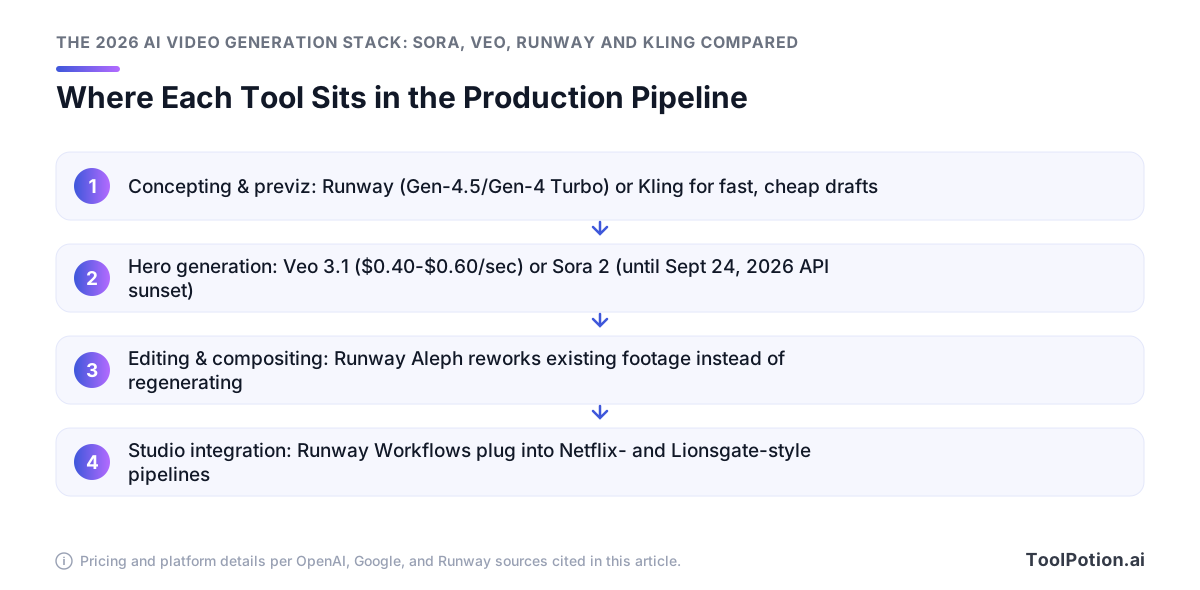
For studio work, Runway's institutional traction matters as much as pricing — Netflix uses it in production, and it has formal partnerships with NVIDIA and Lionsgate (Versely). The Max plan, now open to new subscribers, runs $95/month for 9,500 credits — about 791 seconds of Gen-4.5 output (AumiqX). Every paid tier bundles in Veo 3/3.1 and third-party models like Kling 3.0 Pro, so a Runway Pro or Max seat effectively buys you multi-model access under one subscription (Creatify-plans-credits-and-what-you-ll-actually-pay)).
How These Models Fit Into a Real Production Pipeline
From Prompt to Final Cut
None of these tools produce a finished deliverable on their own. A real pipeline looks like: storyboard and shot list, generate raw clips from one or more of Veo, Runway, or Kling, then pull everything into a compositing and editing layer for color, audio mixing, and cuts between shots.
That last step matters more than most comparisons admit. Per-second generation costs only cover the raw clip — you still need an editor to assemble a sequence, which is why the tools that bundle editing (not just generation) save you the most time on multi-shot projects.
Where Runway's Studio Partnerships Fit In
Runway is the clearest example of a generation tool built to sit inside an existing studio pipeline rather than replace it. Its tools are used by Netflix in production, and Runway has formal partnerships with NVIDIA and Lionsgate (Versely).
That changes what you should expect from the product. A tool with studio partners needs to plug into existing editorial workflows — asset handoffs, version control, review cycles — not just spit out a standalone clip. If your team already works in a professional post-production pipeline, Runway's positioning is a signal that it's built to slot into that pipeline rather than compete with it.
For solo creators or small teams generating one clip at a time, this integration depth is mostly irrelevant — you care about cost per second and output ceiling, not enterprise asset management. But if you're evaluating tools for a production team that already has an editorial pipeline, Runway's studio relationships are a stronger signal than any benchmark score.
Frequently Asked Questions
Is Sora still worth using in 2026?
Not for anything you plan to build on. OpenAI notified developers on March 24, 2026 that the Videos API and every Sora 2 model alias (sora-2, sora-2-pro, and dated snapshots) will be removed from the API on September 24, 2026, with no replacement listed Deprecations | OpenAI API. Free ChatGPT access to Sora was already cut on January 10, 2026, restricting it to Plus ($20/month) and Pro ($200/month) subscribers OpenAI Sora 2 Pricing Policy Update. It's also the most expensive option per second among the major models Sora vs Kling vs Veo vs Runway vs Lovart — 2026 AI Video Deathmatch, so treat it as a legacy option, not a going concern.
What happens to apps built on the Sora API after September 24, 2026?
They stop working. OpenAI gave developers six months' notice — from the March 24, 2026 announcement to the September 24, 2026 shutdown date — to migrate off the Videos API and all Sora 2 model aliases, and listed no recommended replacement Deprecations | OpenAI API. If you have production integrations calling sora-2 or sora-2-pro, you need a migration plan to another provider before that date, not after.
Which AI video generator is cheapest per second in 2026?
Veo 3 Fast, at $0.15/second on Vertex AI following Google's September 8, 2025 price cut (down from $0.40/second) Veo 3 and Veo 3 Fast – new pricing, new configurations and better resolution. Runway's Gen-4 Turbo API rate is close behind at $0.05/second (a flat $0.01 per credit) Runway Gen-4 API: Pricing, Specs, and How to Access It (2026). Sora 2 is the outlier at the top of the range — $0.10/second standard, and a 30-second clip runs about $22.50, roughly 5x Veo 3.1's fast-mode price for comparable output Sora vs Kling vs Veo vs Runway vs Lovart — 2026 AI Video Deathmatch.
Which model supports the longest clips and highest resolution?
Veo 3.1 on Vertex AI/Gemini API scales up to 4K resolution with audio at $0.60/second, versus $0.40/second for 1080p; an 8-second clip at the standard rate costs about $3.20 Veo 3.1 Pricing Guide 2026. Google's September 8, 2025 update also added 1080p HD output and 9:16 vertical support to the Veo 3 line Veo 3 and Veo 3 Fast – new pricing, new configurations and better resolution. Runway's paid plans bundle Gen-4.5 alongside third-party models including Kling 3.0 Pro, so you can route longer or higher-res jobs to whichever model fits inside one subscription Runway Pricing Plan and Usage Tiers 2026-plans-credits-and-what-you-ll-actually-pay).
Is Runway or Kling better for professional video production?
On raw output quality, Kling currently leads: Kling v3 scored 1934 Elo in the text-to-video arena as of August 2026, based on 1,394 blind votes, the top score in that leaderboard Best AI for Video Generation in 2026 — Ranked by Blind Human Votes. Runway's Gen-4.5 launched at 1,247 Elo on the Artificial Analysis benchmark and has since dropped out of the top 10 Sora vs Kling vs Veo vs Runway vs Lovart — 2026 AI Video Deathmatch. But Runway has the deeper production ecosystem — it's used by Netflix, with formal partnerships with NVIDIA and Lionsgate Runway Gen-4 Pricing 2026: Plans, Credits & Cheaper Alternatives — plus every paid plan bundles Gen-4.5, Act-Two performance capture, and Aleph editing tools Runway Pricing Plan and Usage Tiers 2026-plans-credits-and-what-you-ll-actually-pay). If your workflow depends on studio-grade editing and compositing tools, not just raw generation quality, Runway is the stronger pick; if model output quality alone is the deciding factor, Kling wins.
What's the best AI video generator for beginners in 2026?
Runway's Standard plan is the most accessible entry point at $15/month for 625 credits (or $12/month billed annually), and every paid tier from Standard up includes access to Gen-4.5, Gen-4, and even third-party models like Veo 3/3.1 and Kling 3.0 Pro in one interface Runway Pricing Plan and Usage Tiers 2026-plans-credits-and-what-you-ll-actually-pay). Runway's free tier gives a one-time 125 credits that never expire but never renew, useful for testing before you commit Runway AI Pricing 2026: Free Plan, Credits, Max Plan & Best Value. Avoid Kling if you're budget-conscious: its Ultra plan rose from $128/month in August 2025 to $180/month by January 2026, a 41% increase in about six months [Kling AI Pricing (2026): Free vs Paid Plans & Real Video Costs](https://www.atlascloud.ai/blog/tips/kling-ai-pricing]. You can browse other beginner-friendly video tools in our directory's AI Video Generators category.