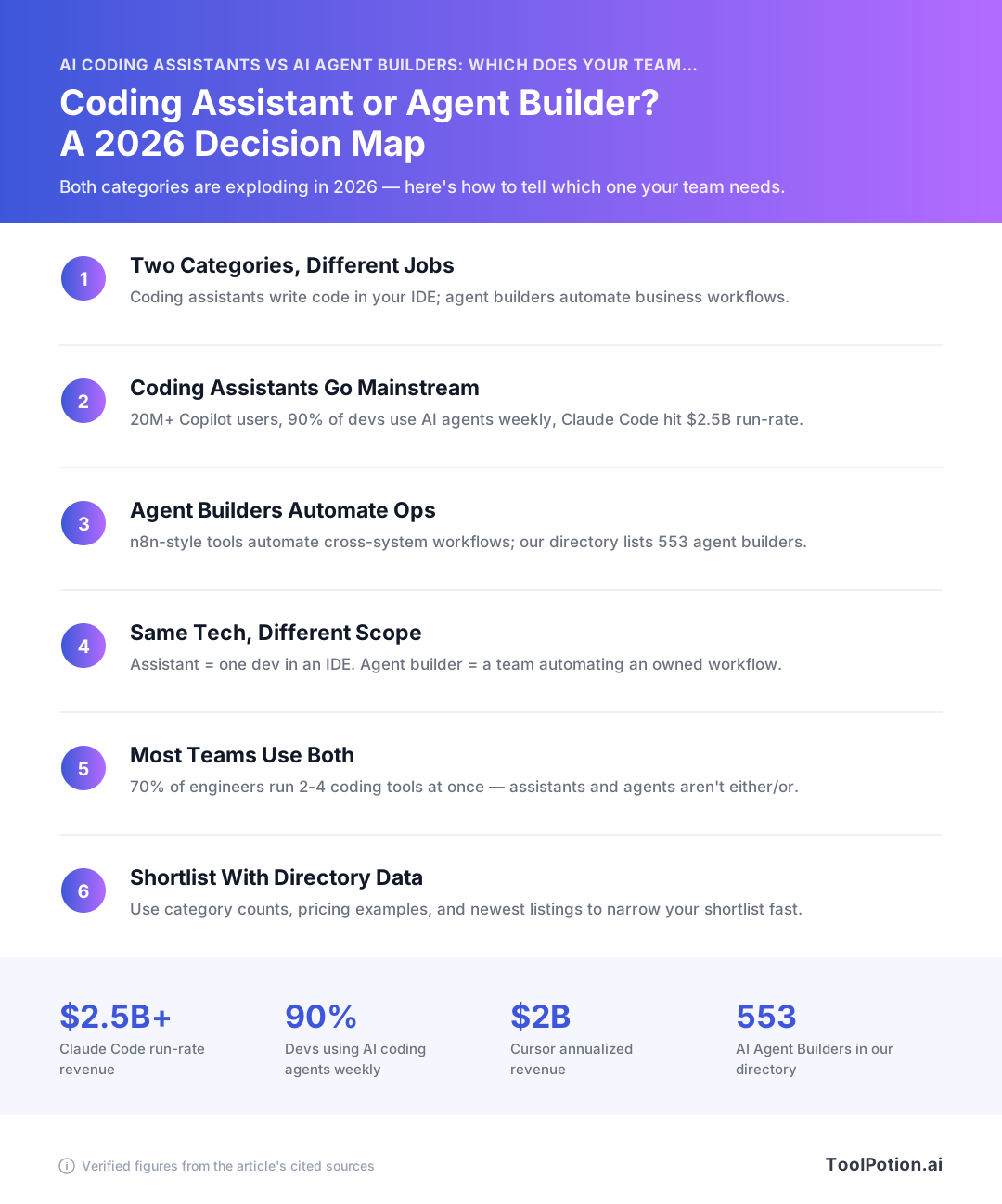
Use an AI coding assistant if you're writing code inside an IDE; use an AI agent builder if you're automating a workflow that spans business systems outside your codebase. Both categories are running at serious scale in 2026: Cursor's annualized revenue passed $2 billion in February 2026 (TechCrunch), Claude Code's run rate topped $2.5 billion that same month (Anthropic), and agent builders like n8n serve a completely different job to be done, billing by workflow execution instead of seats (n8n). This piece compares both categories on current data and gives you a framework to pick between them.
AI Coding Assistant vs AI Agent Builder: What Each Term Actually Means
An AI coding assistant helps a developer write code, inside an editor, with a human reviewing and approving each step. An AI agent builder lets you design a workflow that runs on its own across multiple systems, with far less human review per execution. The difference isn't marketing — it's who stays in the loop and how often.
The assistant model: a human stays in the loop
Tools like GitHub Copilot and Cursor sit inside your IDE and respond to what you're doing: autocompleting a line, answering a question about a function, or drafting a patch you then read and accept. You stay the decision-maker. The tool proposes; you dispose.
The agent-builder model: you architect autonomous workflows
Platforms like n8n take a different shape entirely: you wire together triggers, logic, and actions across apps once, and the resulting workflow then runs unattended — pulling data from a CRM, calling an LLM, and posting to Slack without you clicking through each step. The unit of work isn't a line of code you approve; it's a process you design once and let execute repeatedly.
Why vendors blur the line in 2026
IBM frames the split cleanly: "assistant" describes a tool's relationship to its human user, while "agent" describes its degree of autonomy — and the firm notes vendors increasingly use the two terms interchangeably rather than as separate product categories (IBM). Keep the underlying question — how much does a human review before code ships, or before a workflow fires? — in mind as the comparison gets more concrete below.
How Big Is the AI Coding Assistant Market in 2026?
Adoption: what JetBrains' 15,000-developer survey found
AI coding assistants are no longer a niche habit. JetBrains' 2026 Developer Ecosystem Survey, covering more than 15,000 professional developers, found that 90% use AI coding agents at work at least weekly, and 68% use them daily (JetBrains).
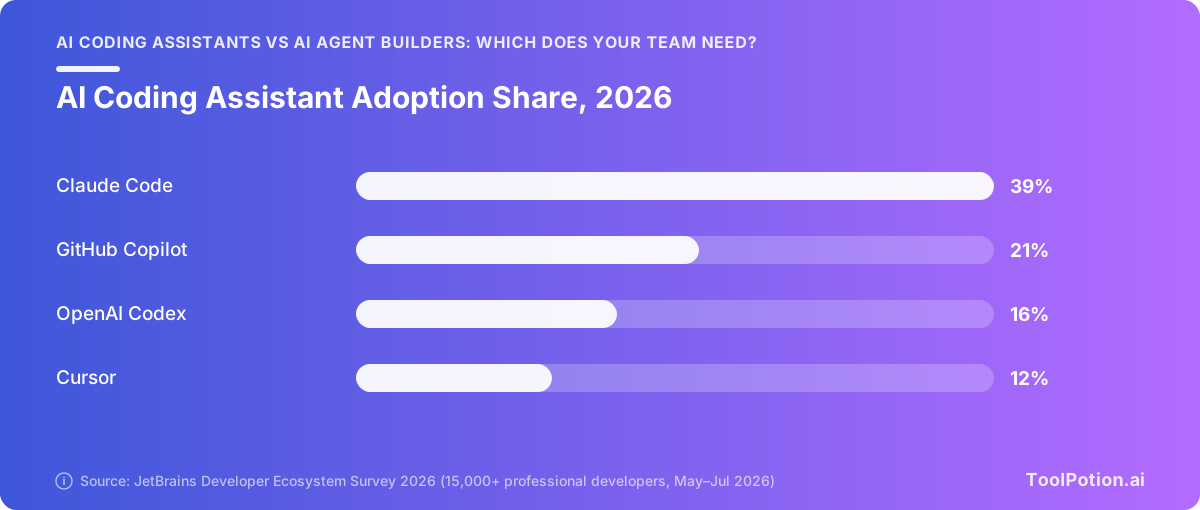
The same survey shows a sharp reshuffling among the leading tools. Claude Code reached 39% global adoption (47% in the US), roughly double GitHub Copilot's 21%, while Cursor slipped to 12%, down from 18% in January 2026 (JetBrains).
That's a fast-moving leaderboard, not a settled one. If you're comparing options for your team, our directory lists 247 AI coding assistants, well beyond the three names dominating the survey data.
Revenue: Copilot, Cursor, and Claude Code by the numbers
Adoption numbers line up with the money behind these tools. Cursor's annualized recurring revenue passed $2 billion in February 2026, having doubled in just the prior three months (TechCrunch).
Anthropic disclosed that Claude Code's run-rate revenue passed $2.5 billion by its February 12, 2026 Series G announcement, more than doubling since the start of the year, and that Claude Code now authors an estimated 4% of all public GitHub commits worldwide, double its share from a month earlier (Anthropic).
| Tool | Key metric | Source |
|---|---|---|
| GitHub Copilot | 21% adoption share among developers | JetBrains |
| Cursor | $2B+ ARR (Feb 2026), doubled in 3 months | TechCrunch |
| Claude Code | $2.5B+ run-rate revenue; ~4% of public GitHub commits | Anthropic |
The takeaway: this isn't a market waiting to prove itself. It's already running at multibillion-dollar scale, with usage patterns shifting month to month rather than year to year.
What AI Agent Builders Do — and What's Live in Our Directory Right Now
An agent builder isn't an IDE plugin. It's a canvas for wiring together triggers, APIs, and logic so a workflow runs without a human clicking through each step — think a support ticket that gets triaged, routed, and answered automatically, not a developer typing in an editor.
No-code workflow builders vs code-first agent frameworks
The category splits into two camps. No-code builders give you a visual canvas of nodes and connectors aimed at business users and ops teams. Code-first frameworks give you a library you import into Python or TypeScript, aimed at engineers who want full control over state, memory, and tool calls. Both count as agent builders because both produce something that runs autonomously once deployed, unlike a coding assistant that stops and waits for you.
Pricing example: how n8n charges for automation, not seats
n8n is a useful illustration because its pricing has nothing to do with how many developers touch it. Cloud plans start at the Starter tier, roughly €20-24/month for 2,500 workflow executions, scaling up to a Business tier around €667-800/month for 40,000 executions plus SSO, SAML, and Git-based version control (n8n). In 2026, n8n made workflows and users unlimited on every Cloud plan, so execution volume is the only lever that moves your bill (n8n). That's the opposite of a coding assistant, which almost always bills per seat.
553 agent builders and counting
We track 553 AI agent builders in our directory, spanning no-code canvases and code-first frameworks alike, plus 550 AI agents listed by type — the deployed workflows those builders produce. If you're comparing platforms rather than just picking one on a vendor's homepage, that's the list to start from.
AI Coding Assistant vs AI Agent Builder: Side-by-Side Comparison
Once you strip away the marketing, the two categories split cleanly on four practical dimensions: what the tool is allowed to touch, who signs off on its output, how you pay for it, and who on your team can actually run it.
| Dimension | AI Coding Assistant | AI Agent Builder |
|---|---|---|
| Autonomy and scope | Touches code inside one repo or editor session; suggests or writes, you approve each change | Touches multiple systems (APIs, databases, ticketing, email) and runs unattended once deployed |
| Who reviews output | A developer reviews every diff before it merges | A workflow owner reviews outcomes periodically, not every individual run |
| Pricing model | Per-seat, per-developer subscription | Metered by workflow executions, with seats often unlimited |
| Skill required | Assumes you can already read and write code | Assumes you can map a business process into triggers and steps, little or no code |
Autonomy and scope of what each tool touches
A coding assistant's blast radius is a codebase. It reads your files, proposes edits, and stops at the point of a commit or pull request. An agent builder's blast radius is a business process — it can read a form submission, call three APIs, and send a Slack message without anyone in the loop for that specific run.
Who owns and reviews the output
With a coding assistant, review is per-change: a developer reads the diff before it ships. With an agent builder, review is per-workflow: someone checks that the automation still behaves correctly on a schedule, not that any single execution was inspected by hand.
Pricing model and who pays
Coding assistants are sold like developer tooling — a monthly fee per engineer. Agent builders are increasingly sold like infrastructure — a fee tied to how many times a workflow actually fires, which shifts the buyer from an engineering manager to whoever owns the process being automated.
Skill required to operate it
A coding assistant assumes you can already write code and judge whether its suggestion is correct. An agent builder assumes you can decompose a process into steps and conditions — a skill closer to process design than programming, which is why non-engineers end up building these workflows too.
Which Does Your Team Need? A Decision Framework
Choose a coding assistant if...
You're shipping code inside a codebase that already exists, and a developer is going to review every change before it merges. If the unit of work is a pull request, not a business process, an assistant is the right shape of tool.
- You have one or a handful of developers who need to move faster inside an IDE, not a team automating a process.
- Every output needs a human diff review before it ships — you're not ready to let a tool merge or execute unsupervised.
- Your budget is a per-seat line item, not a metered usage line — most assistants bill per developer per month, not per run.
Choose an agent builder if...
The work you want automated isn't code review — it's a repeatable business process that spans systems: a ticket gets triaged, a lead gets enriched, a report gets assembled and sent, all without someone clicking through each step.
- The task is a workflow owned by a business team (support, ops, marketing), not a pull request owned by an engineer.
- You need the automation to run on a schedule or trigger, unattended, rather than waiting on a human to review each step.
- Your usage is spiky or high-volume enough that metered pricing makes sense — n8n's Cloud plans bill by execution count, not seats, rather than a flat per-developer fee (n8n).
Signals you've outgrown one for the other
If your developers are pasting AI-assistant output into scripts that glue together three other tools by hand, that's a sign the work has outgrown an IDE plugin and needs an actual workflow engine. If your agent-built workflow keeps needing a developer to patch its generated code before it's trustworthy, that's a sign you need an assistant in the loop upstream, not more autonomy downstream.
Why Many Teams End Up Using Both
The adoption gap between assistants and agents
Stack Overflow's 2025 Developer Survey found 84% of developers use or plan to use AI tools, up from 76% in 2024, but only 31% currently use AI agents at work on any regular basis (Stack Overflow). That gap is the whole story: nearly every developer already has an assistant in their editor, but agent adoption for autonomous, multi-step work is still a minority behavior. The two categories aren't competing for the same job, so adopting one doesn't reduce the need for the other.
A common combo: IDE assistant plus workflow agent builder
In practice, the split tends to land along the same line drawn earlier in this article: a coding assistant stays inside the pull-request loop, while an agent builder runs the business process around it. A developer using Cursor or Claude Code to ship a feature might sit on a team where an n8n workflow files the resulting deploy notification, updates a ticket, and pings a Slack channel — no code review involved, because there's no code to review.
That's why the question isn't really "assistant or agent builder" for most teams — it's which one handles which slice of the work. The unit of work decides the tool, not a company-wide platform bet.
How to Shortlist Tools in Either Category
Evaluating coding assistants for your stack
Start with what already ships inside your editor and CI, since switching costs are real once a team standardizes on one tool's keybindings and review flow. If you're starting from zero, browse the AI coding assistants category and filter by the languages and IDEs your team actually uses rather than picking the tool with the loudest launch post.
Evaluating agent builders for your workflows
Agent builders live or die on the integrations they ship with, since a workflow tool that can't reach your ticketing system or CRM is dead weight. Map the systems the workflow needs to touch first, then compare options in the AI agent builders category for pre-built connectors to those specific systems before you touch pricing.
Using freshness and listing volume as a signal
Category size tells you how contested a space is: our directory currently lists 247 tools under AI coding assistants and 553 under AI agent builders, meaning agent builders are the more crowded, faster-moving category right now (our directory). A high listing count isn't a quality signal on its own, but it does mean more recent entrants to compare against incumbents before you commit budget.
Frequently Asked Questions
Is GitHub Copilot an AI coding assistant or an AI agent?
It functions as both, depending on how you use it — autocomplete behaves like a classic assistant, while more autonomous modes act more like an agent. IBM frames the underlying distinction as UX versus autonomy: "assistant" describes the tool's relationship to its human user, while "agent" describes its degree of independence, and vendors increasingly use the terms interchangeably rather than as separate categories (IBM). You can browse comparable tools in our directory's AI Coding Assistants category.
Can I use an agent builder like n8n to automate coding tasks?
Not for writing code directly — agent builders like n8n orchestrate workflows across systems (triggering scripts, calling APIs, routing tickets) rather than editing source files in an IDE. n8n bills by workflow execution rather than developer seats, and its AI Assistant feature for building agents is included in preview on all Cloud plans except Enterprise (n8n). If the task is repo-level code generation or debugging, a coding assistant like Claude Code or Cursor is the right tool; if it's automating a process that spans tools your code touches, an agent builder fits — see our directory's AI Agent Builders category for options.
What's the difference between an AI agent and an AI agent builder?
An AI agent is the running system that performs a task; an agent builder is the platform you use to configure and deploy that agent. Tools like n8n are builders — you use them to assemble the triggers, logic, and integrations that become a specific agent (n8n). Our directory lists 550 AI Agents and 553 listings under AI Agent Builders, reflecting that the two are tracked as distinct categories (our directory).
Do I need both a coding assistant and an agent builder on my team?
Most engineering teams already treat AI coding assistants as a baseline tool, not an experiment — see the adoption numbers above. Adding a separate agent builder for cross-system automation is a normal extension of that, not redundancy. If your workflows also involve non-code steps owned by other teams — ticket routing, notifications, data syncs — an agent builder like n8n handles that layer while coding assistants stay focused on the repo itself. Whether you need both depends on whether the work you're automating lives inside the codebase or spans multiple business systems.
Which is cheaper: an AI coding assistant or an AI agent builder?
It depends on usage volume rather than category — coding assistants are typically priced per seat, while agent builders are priced per execution. n8n's Cloud pricing starts at roughly €20-24/month for 2,500 executions and rises to about €667-800/month for 40,000 executions at the Business tier, with unlimited workflows and users on every Cloud plan since 2026 (n8n). Coding assistant pricing isn't detailed in the same execution-based terms in the available data, but market scale differs sharply: Cursor's annualized revenue hit $2 billion in February 2026 with roughly 60% now coming from corporate customers, an indicator of how heavily seat-based coding tools are used at the enterprise level (TechCrunch). Compare current listings and pricing models side by side in our directory's AI Coding Assistants and AI Agent Builders categories.